In times of increasing crises and disasters, regions face the challenge of strengthening their resilience and shaping the transformation to a sustainable and livable future. As a research and consulting company based in Bad Neuenahr-Ahrweiler, we witnessed the 2021 flood disaster and are actively contributing our expertise to solutions for practical, climate-adapted reconstruction.
IQIB
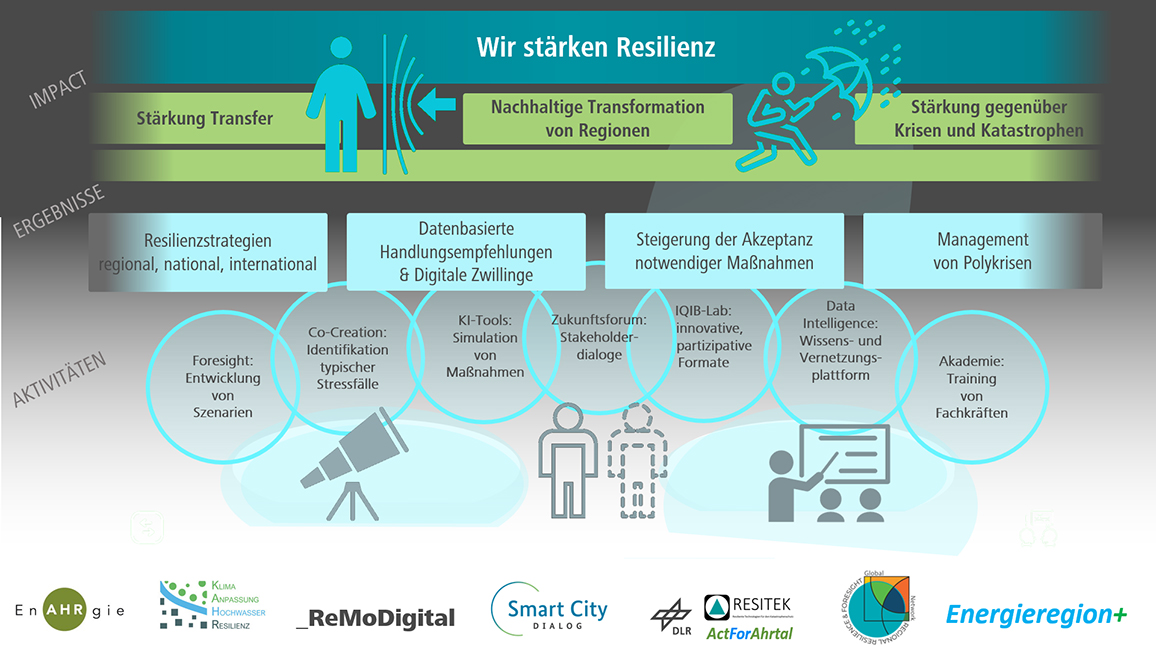
With our transdisciplinary and interdisciplinary research projects and practical initiatives, we contribute to strengthening resilience and climate adaptation – regionally, nationally, and internationally. For us, strengthening resilience means increasing the resistance, recovery, and transformation capabilities of socio-technical systems.
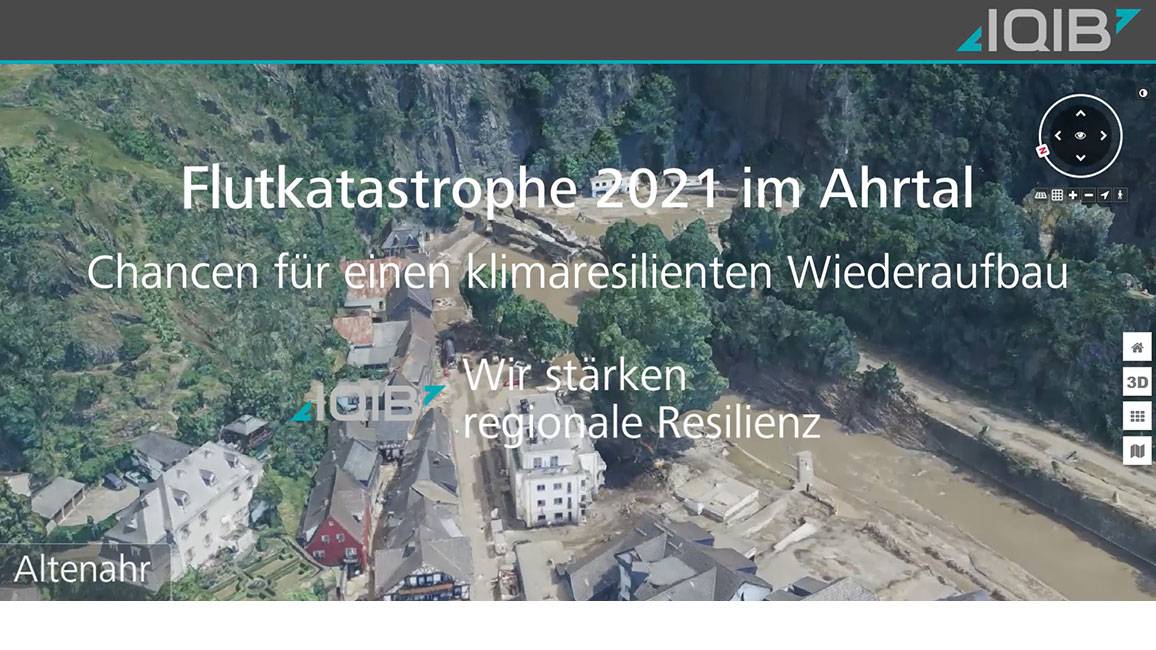
The Ahr Valley after the flood disaster in a flyover
In this video, we take you on a flight over the Ahr Valley – seven days after the flood disaster in July 2021. With the help of 3D aerial photographs and before-and-after comparisons of the situation on the ground, we present links to our projects and initiatives on resilience research and climate adaptation.
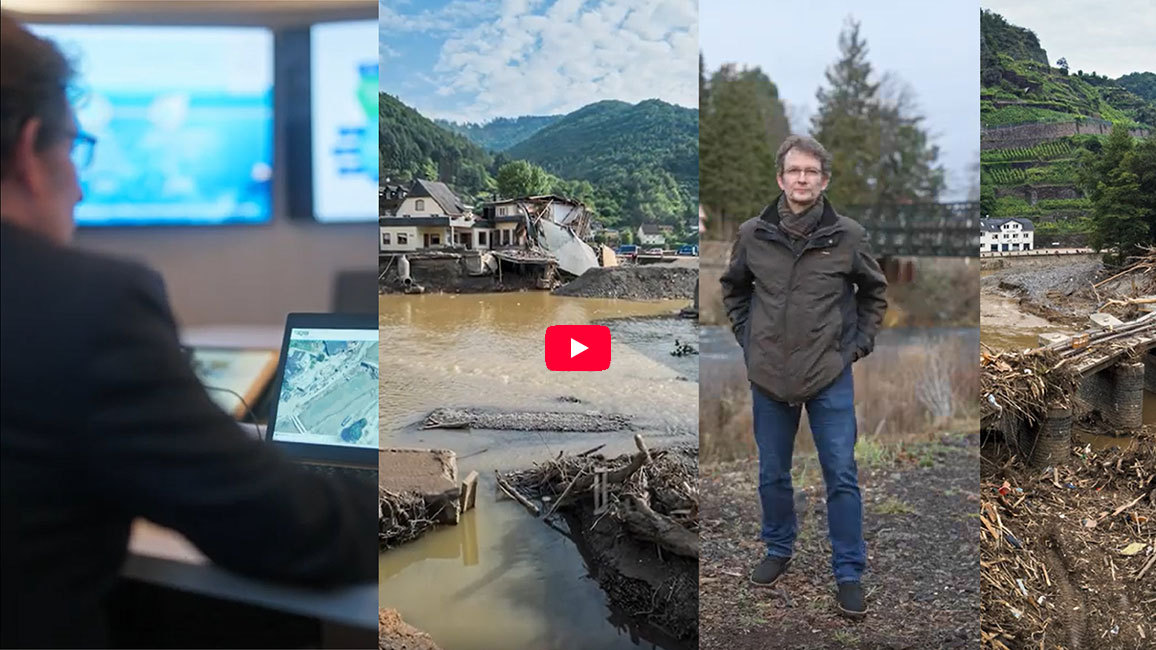
Insight into the 2021 flood disaster – from a personal perspective and as a scientist
In a video contribution, Bert Droste-Franke, Head of “System Evaluation & Societal Future Viability” provides insight into the 2021 flood disaster and IQIB's research on resilience – from a personal perspective and as a scientist. The video is also part of the permanent exhibition “Extreme Weather” at the Klimahaus in Bremerhaven.
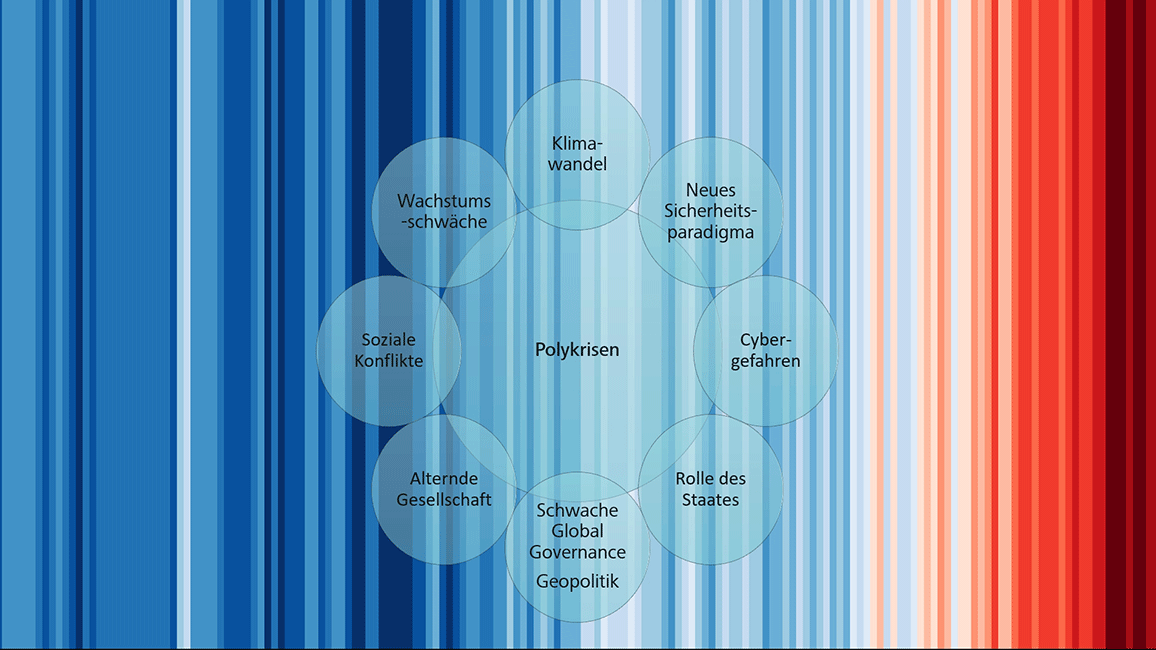
Natural disasters are becoming more frequent as a result of climate change, and in some cases are accompanied by cascading risks – in the technological, social, and economic spheres. Increasingly, individual crises are even overlapping to form polycrises. This threatens the livelihoods of many people: technological, social, and societal developments are destroyed, and planetary health is endangered. Disaster preparedness is therefore an absolute necessity for our society.
The so-called “warming stripes” by British climate researcher Ed Hawkins impressively illustrate global warming. The stripes illustrate the average temperature of a single year as a narrow-colored stripe. Dark blue stands for cool and dark red for warm – when lined up, the stripes form a bar code that shows how warm years have been accumulating in recent times. The stripes are based on the HadCRUT4 temperature data set from the British Met Office for the period from 1850 to 2023. More information
What we mean by resilience
Resilience is the ability and capacity of a socio-technical system to maintain or quickly restore its services to society, even under severe stress. Based on van Doren et al. (2025): Resilience Monitoring (working title), Springer-Verlag, in particular contribution: Ortwin Renn et al. (2025): Coping with complexity – A systems approach to resilience
Our services
We develop strategies and concepts for politics, administration, and municipalities to strengthen resilience and climate adaptation – tailored to the Federal Climate Adaptation Act (KAnG).
Applied research
We conduct research on the resilient design of the digital energy transition and on the sustainable, climate-adapted, and resilient transformation of urban and regional areas in the implementation of the Climate Adaptation Act.
We model scenarios and develop strategies for changing focus topics in the field of energy, e.g., the ramp-up of hydrogen in the Ruhr region and the smart use of renewable energies (“virtual power plants”).
analyse and evaluate socio-technical systems based on agent-based modeling,
visualise complex relationships in our Innovation Lab,
coordinate transfer activities for Rhineland-Palatinate as part of the “Climate Adaptation, Flooding, Resilience” (KAHR) project
supporting climate-adapted reconstruction in the Ahr Valley after the 2021 flood disaster together with research institutes of the German Aerospace Center (DLR) – especially in the areas of mobility and energy,
as a subsidiary of DLR, acting as a link to the expertise of the DLR research institutes.
Monitoring systems, tools, and indicators
We develop monitoring systems and tools for better decision-making,
support (municipal) reporting and monitoring of climate adaptation strategies,
develop indicators to measure the progress of implemented measures.
Data analysis and management
We use data intelligence for the management of large data sets (e.g., climate data).
We carry out simulations on the use of renewable energies and resilient energy systems.
Consulting & strategy
We develop strategies and concepts for politics, administration, and municipalities to strengthen resilience and climate adaptation.
We advise on strengthening resilience, for example, in energy supply, the digitization of administration, and the mobility system in the context of climate change.
We use our urbanSPICE approach for strategic consulting and support for municipalities on their way to becoming smart and sustainable communities.
Qualification & Training
We offer training courses to increase resilience (e.g., foresight training),
training courses on capacity building/qualification in the context of urban diplomacy (international cooperation between municipalities), and
conduct further training for municipalities on the topic of climate adaptation.
Participatory formats & citizen participation
We develop and implement participatory formats, for example citizen participation concepts for involving the public in the development of climate adaptation strategies.
Risk & crisis management
We design future scenarios and analyse risks using scientific methods of strategic foresight,
develop digital twins to visualise scenarios,
model and visualise crisis and disaster scenarios, and design roadmaps for disaster preparedness.
Strengthening inter-municipal cooperation
We strengthen regional, national, and international cooperation between municipalities, cities, and communities through networks.
Our projects and initiatives on resilience research and climate adaptation
IQIB
Resilience monitoring for the digitalization of the energy transition (ReMoDigital)
IQIB
Tool for designing resilient energy systems
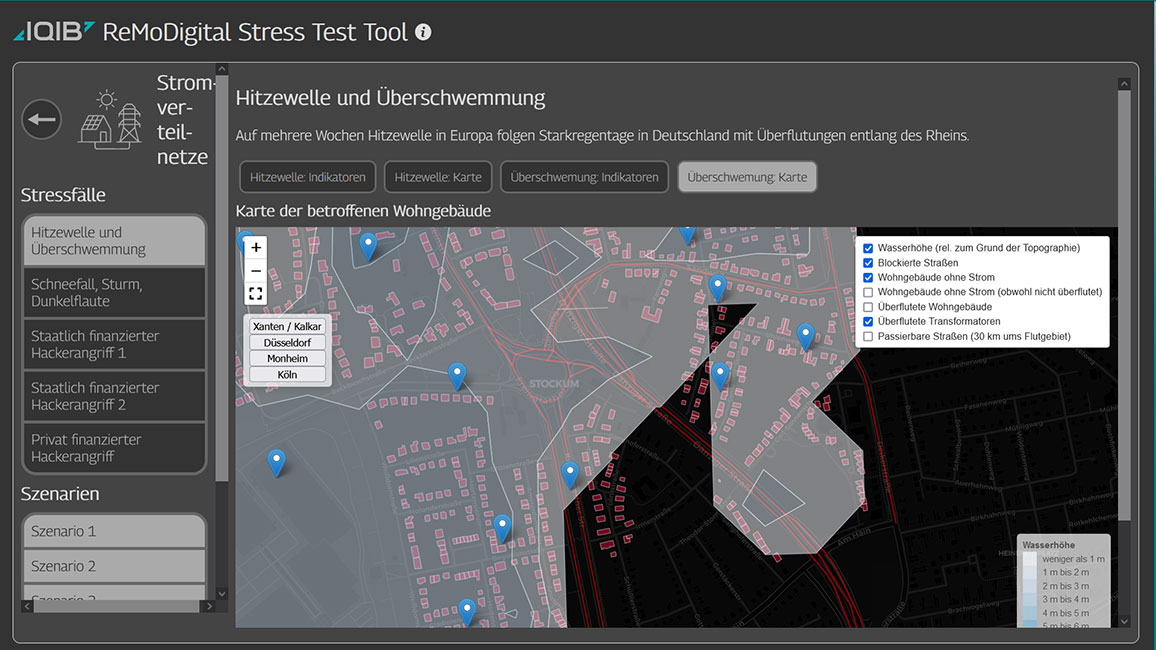
We are developing a tool for the co-creative, resilient design of future energy systems in transdisciplinary, discursive processes with the help of defined stress cases and selectable future scenarios.
Analysis of disasters and crises
We analyse examples of regional impacts of extreme events (heat/floods, snowfall/storms, hacker attacks) against the backdrop of various social, technological, and digital developments.
Resilience monitoring and recommendations
Together with experts, we develop recommendations for dealing with resilience and resilience monitoring in general and in relation to the design of resilient energy systems.
In the KAHR project funded by the Federal Ministry of Education and Research (BMBF), we provide the project office for Rhineland-Palatinate. We are committed to improved disaster control and climate-adapted, innovative, resilient reconstruction. n.
Transfer into practice
We ensure the transfer of research results into practice through our “Transfer Radar” and “Transfer Toolbox” instruments.
Knowledge and information management system
We support climate-adapted reconstruction with a knowledge and information management system we developed ourselves for the dynamic analysis of needs and stakeholder constellations after disasters. . More information The Federal Ministry of Education and Research (BMBF) is funding this project/initiative as part of its “Research for Sustainability” (FONA) strategy www.fona.de.
EnAHRgie
Participatory design of smart, resilient regions
In this project, funded by the Federal Ministry of Education and Research (BMBF), we have implemented participatory formats with stakeholders from science and practice to strengthen regional resilience in areas such as energy supply, transportation, and digitisation. More information
Smart Cities – Strengthening urban resilience
Rotterdam is part of the “Resilient Cities” network
Rotterdam/Central Station, Jurriaan auf Unsplah
A resilient urban system responds robustly and flexibly to shocks and chronic stress while remaining capable of development. Specific local conditions must be taken into account. The federal government's “Smart Cities” model project paves the way for cities, municipalities, and local authorities to achieve a livable, resilient, inclusive, and sustainable future. As a partner of the “Coordination and Transfer Office for Smart Cities Model Projects” (KTS), we ensure the central component of knowledge transfer and are establishing a central knowledge and networking platform. More information
“Urban Diplomacy” thematic group in the international network “ENRICH Global”
“Urban Diplomacy” addresses municipalities as key players in the formulation and implementation of foreign policy. For the multilateral coordination of this topic, we have established the “Urban Diplomacy” thematic group, which is embedded in the international network ENRICH Global. More information
Global Network for Regional Resilience Foresight
This network brings together partners from the fields of research, innovation, education, and think tanks from various countries around the world. Its goal is to harness and further develop the potential of strategic foresight and other methods of futurology to make regions more resilient. To this end, it works closely with practitioners and various thematic experts. The members come from Armenia, Brazil, Germany, France, Kazakhstan, Madagascar, Malawi, Nepal, the Netherlands, and Senegal, and some of them see themselves as regional transfer hubs for the network's expertise.. More information
Regional disaster control network for coping with major flooding and heavy rainfall events
e support the regional “Disaster Control Network for Coping with Major Floods and Heavy Rainfall Events” in our role as project office for Rhineland-Palatinate within the framework of the research project “Climate Adaptation, Floods, Resilience” (KAHR). More information